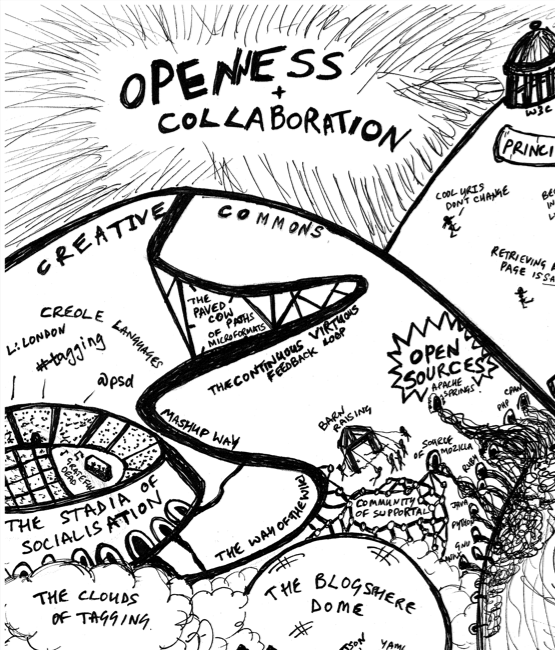
I never reveal my sources. I always give attribution. I never use absolutes. I am never conflicted.
- vanity |ˈvanətē| noun:
-
- excessive pride in or admiration of one's own appearance or achievements
- the quality of being worthless or futile : the vanity of human wishes
- demanding |diˈmandi ng| verb:
-
- ask authoritatively or brusquely
- required to work hard, to meet high standards
As someone who has put too many photos on Flickr, made the odd mad poster, jammed together a bunch of slideshows, recorded one or two stupid videos and scratched out the odd rambling blog post, I've found great value publishing under a Creative Commons (CC) license. For me, Creative Commons has one important feature: people don't need to ask before quoting, reproducing or otherwise reusing my stuff in their stuff, which in turn means I don't have to be bothered by people asking for permission to use stuff. For whatever. Great!
For the most part this has worked extremely well, though I still receive half a dozen or so permission requests a week, often from people oblivious of the CC license, or who are sat behind automated services such as Schmap or Now Public which seem to blindly crank out request emails. Then there are old word print publishers and film makers who need a physical declaration the work is really mine. On more than one occasion I've answered the phone only to be asked to print out, sign and send back a release form just so they can use my thing. Puh-lease! I have helped a couple of people out in this way, but as time goes on, access to things like Word, printers, fax machines is getting harder and my tether, shorter.
With CC I can also choose to prohibit commercial use, I don't. I can also demand attribution, which I do mainly because the Flickr License Preferences doesn't include anything like the wonderful WTFPL which is a shame, because I think there is great value in a burgeoning Public Domain. You see, I maybe too cool for school, but I'm really not bothered about maintaining control. I'm just happy for people to use my stuff to make the Web a bigger, and hopefully, better place.
The antithesis of the commons idol I'm describing, is an unloving world of bizarre controls, in your face bouncing adverts, intrusive watermarks, copyright notices longer than the meanest of extracts, content hidden behind member and pay walls. Worrying about not being ripped off, whilst presumably enjoying the collective fruit of the commons strikes me a little like drinking from the village pump, processing it, then selling the results as mineral water. But these days are all numbered. I was tempted to Fisk the article Why Photographers Hate Creative Commons, until seeing how many commenters had already called "FUD". Positions such as this, are a cry from the past for help to maintain yet another broken business model dependent on creating artificial scarcity, unable to compete with the commons and a world of "free".
All of this hippy-happy talk of freedom is not to say I don't like attribution. Like most proud people, I crave it, in particular links to my blog or the photo, because on the Web and with Pagerank, to link is to love. I also enjoy receiving notice, a short email which says, "you might like to know, we used your photo in this blog post", or even an offer to donate to a good cause can really brighten up the day. Such acts are great for the personal pride, whilst helping build the commons. Making the world a better place is good enough reason for us all to exist, and we can do that whilst farting around. Don't let anybody tell you any different.
If someone does find giving me attribution too demanding for them, or not appropriate to the form of their work, then so be it. Chances are my demanding it will be in vain, and if it's someone who really should know better, chances are they'll be found out. When a company copies a work or even an idea for an advert from Web culture, or infringes a Creative Commons License, they lose credibility, damaging what little good the original campaign may have done for them. Even without demanding, should you care enough about someone not giving attribution, you can enlist everybody's help to embarrass a leech, and whilst a Creative Commons legal challenge is of great use under the current world order, simple embarrassment will often work better, especially as more people get a clue and understand the high value of politeness.
Sadly, in the bucket marked "impoliteness", we find the BBC. This is possibly surprisingly given the number of great people who work there, except when it comes to intellectual property, the BBC has been overly sensitive to the 20th century publishing world, and yet are empirically less loving when it comes to the commons. Take the experience of Cristiano, who has some great shots on Flickr, some of which he's proud of appearing in Flickr Explore 1. In an article about Girl Geek Dinners, the new site used a couple of Cristiano's CC licensed pictures including one of Sarah Blow. Great! Unfortunately, Initially they put a text credit in the image alt tag, something only momentarily visible when hovering over the photo in some browsers and unlikely to show up in an ego search. Certainly that wasn't in the spirit, if not the letter, of the clear CC guidelines for crediting material in your work 2. Cristiano failed to see his credit and the BBC responding quickly, added a line beneath the pictures "(Credit: Cristiano Betta)". The bare minimum one expects is a link from the image to the original photo page and politeness would demand a link to Cristiano himself, and given the content of the article, to Sarah. Badly Behaving Corporation.
Watching this unfold on Twitter prompted my snarky tweet:
Giving clear attribution is politeness. Demanding attribution, vanity.
to which Kevin, the Web man's Web man, coined a fabulous snowclone of The Robustness Principle 3:
@psd postel's law of attribution? "be liberal in what you attribute, conservative in attribution you demand?"
Here's the nub: good things come to those who publish, share, relax, don't care because ..
Notes:
- For the record, and my own vanity, I also have some photos in Flickr Explore. Mostly they're old and teh suck.
- I notice Cristiano's Profile now explains his preferred method of attribution, probably as a result of this experience.
- As a sometime serial implementer of the FTP protocol, a grey-bearded face stared out from a photograph on my desk. I never had the pleasure of meeting him, but he is sorely missed, even after 10 years.
Credits: this blog post is in the Public Domain, and was brought to you from the crowded, lumpy seats of London Midland Trains, smooth goodness of a Monmouth Coffee and the apposite tunes of Texas and Carly Simon. No animals were harmed during the writing of the post, but if I get my hands on the cat that crapped on our lawn ..